Customer Story · Hospital Management Software
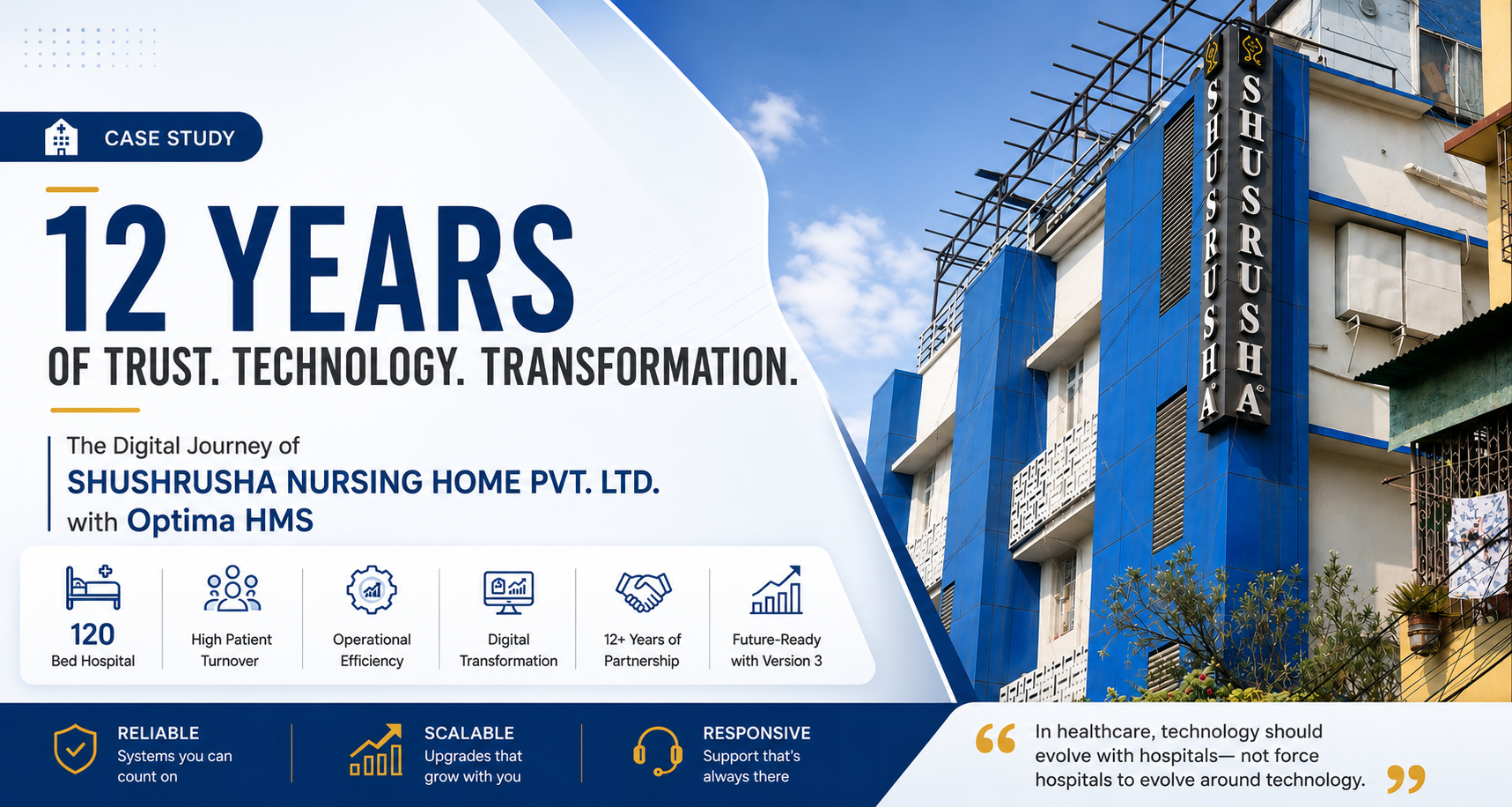
Long-term software partnerships are rare in healthcare IT. Here’s how a 120-bed hospital grew alongside Optima HMS — through two major versions, and into a third.
In healthcare technology, most vendor relationships don’t survive a decade. Systems get replaced, hospitals switch platforms, and institutional knowledge is lost in the process. Shusrusha Nursing Home’s twelve-year relationship with Optima HMS is the exception — and it’s a useful case study in what makes a hospital management system worth staying with for the long haul.
Shusrusha Nursing Home Pvt. Ltd. is a 120-bed hospital built around a straightforward mission: deliver consistent, dependable patient care at a scale that mid-sized facilities can actually sustain. With high OPD and IPD patient turnover and a tight focus on operational efficiency, Shusrusha has spent over a decade as an Optima HMS customer, adopting each major release as its own operations have grown more complex.
Unlike large tertiary hospitals with dedicated IT departments and multi-crore technology budgets, mid-sized nursing homes like Shusrusha need software that does more with less — fewer clicks, fewer support tickets, and a lower total cost of ownership, without compromising on billing accuracy or patient safety.
Mid-sized hospitals operate in a performance-sensitive environment. Front-desk staff, pharmacists, nurses and billing teams all rely on the same system simultaneously, often during peak OPD hours when a slow screen translates directly into a longer queue in the waiting room. For a facility like Shusrusha, the hospital management system isn’t a back-office tool — it’s the backbone of daily patient throughput.
That’s why scalability matters as much as feature depth. A hospital management system that works well at 40 beds has to keep working at 120 beds, and keep working when patient volumes double during flu season or a local health camp. Optima HMS was built with that trajectory in mind, which is a large part of why the partnership has lasted this long.
Phase 1 · Foundation
When Shusrusha Nursing Home adopted Optima HMS Version 1, the goal was foundational: move off paper-based and spreadsheet-driven processes and onto a single, reliable digital system.
Phase 2 · Optimization
As patient volume increased, Shusrusha’s requirements shifted from “get it digital” to “make it fast and visible.” Version 2 focused on performance, reporting and operational control across departments.
Phase 3 · What’s Next
Healthcare IT continues to evolve, and Shusrusha is now preparing for its next upgrade. Version 3 is designed for hospitals that need modern performance without a disruptive system replacement — the same continuity-first philosophy that has defined this partnership from the start.
Twelve years is a long time in software. The relationship between Shusrusha and Optima HMS has held together because of a handful of consistent factors: reliable day-to-day performance, upgrades that scale with the hospital rather than forcing a rebuild, responsive technical support when issues do come up, and — critically — minimal operational downtime during transitions between versions.
A hospital handling high patient volume needs software that keeps pace with the rhythm of daily operations — rapid bed turnover, frequent OPD consultations, high pharmacy billing volume, and a continuous cycle of admissions and discharges. When any one of those workflows slows down, the effects ripple across the entire facility.
Fast invoice generation and package billing reduce front-office congestion, so patients spend less time waiting at the billing counter and more time in care.
Batch tracking, expiry monitoring, and billing that’s integrated directly with inventory help minimize stock leakage and reduce the manual reconciliation work pharmacy teams have historically had to do.
Digital medical records improve documentation quality and continuity of care, giving clinicians a clearer, more complete picture of each patient’s history.
Automated discharge summaries cut down on administrative delays that would otherwise keep beds occupied longer than necessary.
Version-to-version upgrades are built to protect historical data and minimize migration risk, which is exactly what has let Shusrusha move from Version 1 to Version 2, and now toward Version 3, without losing over a decade of records.
Healthcare organizations store decades of sensitive patient information, and every system migration carries real risk to that data. This is why upgrading an existing platform is almost always preferable to ripping and replacing it outright.
The migration to Version 3 represents more than a routine software upgrade — it’s the next step in a partnership built around modernization, performance optimization, enhanced cybersecurity, and analytics-driven decision making for hospital leadership.
“In healthcare, technology should evolve with hospitals — not force hospitals to evolve around technology.”
Shusrusha Nursing Home’s 12-year journey with Optima HMS demonstrates how a scalable hospital management system can evolve alongside a healthcare institution. Through continuous innovation, structured upgrades, and reliable support, Optima HMS has enabled the hospital to improve operational efficiency, strengthen patient care, and prepare for the future of digital healthcare.
See how Optima HMS handles OPD, IPD, billing, pharmacy and EMR for hospitals of every size.
Fill out the form below, and we will be in touch shortly.